

Finerenone
FINE-ONE Study
SUMMARY1
- FINE-ONE is a global, randomized, phase III study, that assessed the efficacy (by urinary albumin-creatinine ratio [UACR] reduction) and safety of finerenone, in addition to standard of care (SoC), compared with placebo, in 242 adult patients with chronic kidney disease (CKD) and type 1 diabetes (T1D).
- Inclusion criteria: ≥18 years old with T1D, an HbA1c <10%, clinical diagnosis of CKD defined as estimated glomerular filtration rate (eGFR) ≥25 to <90 mL/min/1.73 m2 and uACR ≥200 to <5000 mg/g, on stable angiotensin converting enzyme inhibitor [ACEi] or angiotensin II receptor blockers [ARB] treatment and serum potassium ≤4.8 mmol/liter.
- Patients were randomized 1:1 to receive either finerenone 10 mg or 20 mg once-daily (OD) (based on eGFR and serum potassium levels) or matching placebo.
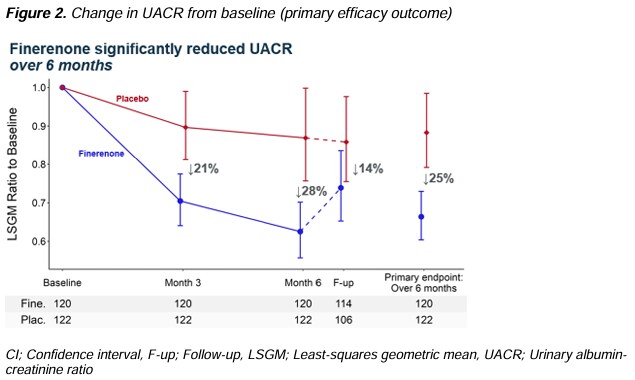
- The primary endpoint was change in UACR from baseline over 6 months. UACR was used as a bridging biomarker, since the treatment effect of finerenone on UACR was associated with efficacy on kidney outcomes in the type 2 diabetes (T2D) trials. Finerenone significantly reduced UACR over 6 months by 25% compared with placebo. Least squares geometric mean (LSGM) finerenone/placebo ratio = 0.75 (95% Confidence interval [CI] 0.65-0.87); P<0.001.
- Secondary safety endpoints (from baseline up to 7 months): Treatment emergent adverse events (TEAEs), treatment emergent serious adverse events (TESAEs), and hyperkalemia leading to discontinuation were not common: any TEAE: 56 (47.1%) participants receiving finerenone vs 60 (49.2%) receiving placebo, any TESAE: 14 (11.8%) vs 14 (11.5%), any TEAE of hyperkalemia: 12 (10.1%) vs 4 (3.3%), respectively.
This page is intended for US healthcare professionals and may contain information outside of the approved prescribing information. It is provided in response to an unsolicited request. It is not intended as an endorsement of any usage not contained in the Prescribing Information. This response should be reviewed together with the current full Prescribing Information (including Boxed Warning) and Medical Safety Summary. These materials contain the approved indications, contraindications, warnings and precautions, adverse reactions, and other important safety information for Kerendia® (Finerenone).
Kerendia is a non-steroidal mineralocorticoid receptor antagonist (nsMRA) indicated to: reduce the risk of sustained estimated glomerular filtration rate (eGFR) decline, end-stage kidney disease, cardiovascular death, non-fatal myocardial infarction, and hospitalization for heart failure in adults with chronic kidney disease (CKD) associated with Type 2 diabetes mellitus (T2DM); reduce urinary albumin-to-creatinine ratio (UACR), which is expected to reduce the risk of sustained eGFR decline and end-stage kidney disease in adults with CKD associated with Type 1 diabetes mellitus (T1DM); reduce the risk of cardiovascular death, hospitalization for heart failure, and urgent heart failure visits in adults with heart failure with left ventricular ejection fraction (LVEF) ≥ 40%.
BACKGROUND
CKD is a common complication in T1D, with up to 30% developing diabetic kidney disease (DKD). For those who develop CKD, there is a 90% risk of progression to heart failure (HF), atherosclerotic cardiovascular disease (ASCVD), or death.2
Despite treatment with renin-angiotensin system inhibitors, the historical standard of care for this population, outcomes and mortality rates for patients with T1D and CKD remain high in recent years.3
Previously, research has focused on CKD associated with T2D, leading to therapeutic advancements. However, there remains a need for therapies that specifically address CKD progression and cardiovascular (CV) risk in patients with T1D, as effective treatment options for this group are limited. 3,4
The nonsteroidal mineralocorticoid receptor antagonist finerenone has been shown to decrease the risk of kidney failure and CV events in people with T2D and CKD.5-7 In the FIDELIO-DKD and FIGARO-DKD pooled population (FIDELITY) (UACR ≥200 mg/g and eGFR between 25 and 90 mL/min/1.73 m2 ) the proportion of the treatment effect of finerenone on the composite kidney endpoint (onset of kidney failure, a sustained decrease in eGFR ≥ 40% over at least 4 weeks or kidney-related death) associated with changes in UACR was 87%.8
In FINE-ONE, UACR reduction was used as a bridging biomarker to translate efficacy evidence of finerenone in people with T2D and CKD to those with T1D and CKD.1
STUDY DESIGN
FINE-ONE is a global, randomized, double-blind, multicenter, placebo controlled, phase III study, that assessed the efficacy (by UACR reduction) and safety of finerenone, in addition to SoC, (ACEi or ARB treatment) compared with placebo, in 242 adult patients with CKD and T1D.1
Patients were assigned to either finerenone (n=120) 10 mg or 20 mg OD (10 mg OD for patients with eGFR ≥25––<60 mL/min/1.73 m2 and 20 mg OD for patients with eGFR ≥60 mL/min/1.73 m2 ) or placebo (n= 122) (Figure 1). From month 1 onwards, the dose of finerenone was increased to the target dose of 20 mg OD, provided serum potassium concentration was ≤4.8 mmol/L and eGFR decrease was <30% compared with the prior visit measurement.1
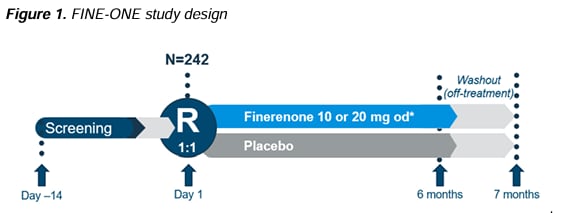
*Starting dose of finerenone: 10 mg OD if eGFR ≥25––<60 ml/min/1.73 m2, or 20 mg OD if eGFR ≥60 ml/min/1.73 m2 eGFR, estimated glomerular filtration rate; od, once daily; R, randomization
Participant key eligibility criteria included:1
- Adults ≥18 years
- T1D with glycated hemoglobin <10%, treated continuously with insulin
- (initiated within 1 year of diagnosis of T1D)
- CKD with eGFR ≥25–<90 mL/min/1.73 m2 and UACR ≥200–<5000 mg/g
- Serum potassium ≤4.8 mmol/L
- On a stable dose of ACEi or ARB for >1 month prior to screening visit
Key exclusion criteria included:1
- T2D, kidney disease other than T1D, or kidney transplantation
- Elevated blood pressure (mean blood pressure >160/100 mm Hg or mean systolic
- blood pressure [SBP] <90 mm Hg)
- Symptomatic heart failure with reduced ejection fraction with class 1A indication for steroidal mineralocorticoid receptor antagonists
- Previous or current treatment with a sodium-glucose co-transporter-2 inhibitor (SGLT2i) or glucagon-like peptide-1 receptor agonist (GLP1-RA)
The primary efficacy outcome was the relative change in UACR from baseline over 6 months. In an exploratory analysis, the primary outcome was also assessed in patient subgroups, including baseline UACR and eGFR.
Other exploratory outcomes:
- the change in UACR from baseline to months 3 and 6
- the proportion of participants with a relative decrease in UACR of ≥30% and ≥50% from baseline at month 6
- Changes in eGFR, blood pressure and serum potassium over time
The secondary safety outcomes included the number of patients with TEAEs or TESAEs and the number of patients with hyperkalemia.
RESULTS
Demographic and baseline characteristics were well balanced between the treatment arms. A total of 84 patients (34.7%) were female and 175 (72.3%) were white. Patients had a mean age (standard deviation [SD]) of 51.6 years (13.7) and a mean T1D duration of 32 years (14.2). The comorbidity burden was high, with 207 (85.5%) and 61 (25.2%) of patients with a history of hypertension and cardiovascular disease (CVD), respectively. Further baseline characteristics and demographics are detailed in Table 1.
Table 1. Baseline characteristics and demographics
| Finerenone(N=120) | Placebo(N=122) | |
Age (years), mean, SD | −51.3 ± 14.2 | 51.6 ± 13.2 |
Sex, n (%) Male Female | 79 (65.8) 41 (34.2) | 79 (64.8) 43 (35.2) |
Race, n (%) White Asian Black Other | 85 (70.8) 23 (19.2) 9 (7.5) 3 (2.5) | 90 (73.8) 25 (20.5) 6 (4.9) 1 (0.8) |
BMI (kg/m2), mean, SD | 27.7 ± 5.4 | 27.3 ± 6.6 |
eGFR (mL/min/1.73m2 | 59.0 ± 19.5 | 58.8 ± 19.0 |
UACR (mg/g), (Q1-Q3) | 574.6 (315.8 – 1224.9) | 506.4 (288.2-1182.3) |
Serum K+(mmol/L), mean, SD | 4.6 ± 0.4 | 4.6 (0.4) |
SBP (mmHg), mean, SD | 136.5 ± 15.8 | 134.2 ± 17.7 |
DBP (mmHg), mean, SD | 78.5 ± 10.4 | 76.7 ± 11.2 |
Medical History, n (%) Cardiovascular disease Hypertension | 35 (29.2) 104 (86.7) | 26 (21.3) 103 (84.4) |
Duration of T1D (years), mean, SD | 32.0 ± 14.1 | 32.0 ± 14.4 |
Concomitant Medications, n (%) ACEI ARB Diuretics | 59 (49.6) 60 (50.4) 43 (36.1) | 52 (42.6) 68 (55.7) 45 (36.9) |
Efficacy Results
From baseline to 6 months, the median UACR ratio changed from 574.6 mg/g to 373.5 mg/g with finerenone compared with 506.4 mg/g to 475.6 mg/g with placebo.
The geometric mean percentage changes from baseline over 6 months were 12% LSGM ratio to baseline 0.88; 95% CI 0.79, 0.98) for placebo and 34% (least-squares mean ratio to baseline 0.66, 95% CI 0.60, 0.73) for finerenone. Corresponding to a significant reduction in UACR over 6 months of treatment by 25% compared with placebo LSGM 95% CI 0.75 [0.65; 0.87]; P < 0.001) (see Figure 2).
At 6 months, more participants treated with finerenone experienced a reduction in UACR from baseline of at least 30%, or 50% compared with the placebo group (Table 2).
Table 2. Clinically important decreases in UACR from baseline (Exploratory outcome)
| Relative decrease from baseline | Visit | Finerenone (N=120) n/n* (%) | Placebo (N=122) n/n* (%) |
| ≥30% | Month 3 | 52/115 (45.2%) | 33/113 (29.2%) |
| Month 6 | 63/116 (54.3%) | 36/110 (32.7%) | |
| Any time post-baseline* | 81/119 (68.1%) | 54/116 (46.6%) | |
| ≥50% | Month 3 | 24/115 (20.9%) | 13/113 (11.5%) |
| Month 6 | 33/116 (28.4%) | 24/110 (21.8%) | |
| Any time post-baseline* | 43/119 (36.1%) | 36/116 (31.0%) |
*Defined as the maximum post-baseline decrease and includes unscheduled assessments performed after randomization
Safety Results
TEAEs were similar between treatment groups, with 56 (47.1%) and 60 (49.2%) TEAEs and 14 (11.8%) and 14 (11.5%) TESAEs reported in the finerenone and placebo groups, respectively.
Hyperkalemia occurred in 12 (10.1%) patients on finerenone, of which 2 (1.7%) cases lead to discontinuation of the study drug and 4 (3.3%) patients on placebo. No cases of hyperkalemia led to death in either group. Serum potassium >5.5 mmol/L occurred in 13/118 (11.0%) patients treated with finerenone and 4/115 (3.5%) with placebo, while elevations >6.0 mmol/L were observed in 2/119 (1.7%) and 1/117 (0.9%) patients, respectively.
Hypoglycaemia occurred in 2 (1.7%) patients with finerenone and 7 (5.7%) with placebo. Hypotension occurred in 3 (2.5%) patients and 1 (0.8%) patient with finerenone and placebo, respectively, and acute kidney injury occurred in 2 (1.7%) patients in the finerenone group and no patients in the placebo group.
Other exploratory outcomes
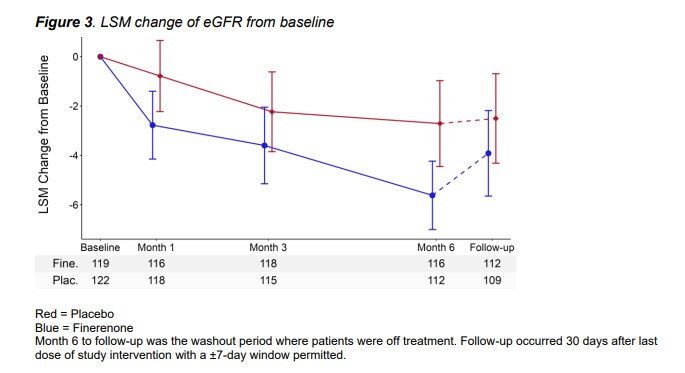
The maximum difference in least square mean (LSM) change of eGFR from baseline between both treatment groups was seen at month 6 (–2.9 ml/minute/1.73 m2[95% CI: –5.1, –0.7]). In the finerenone group the decrease was reversable 30 days following treatment discontinuation (Figure 3).
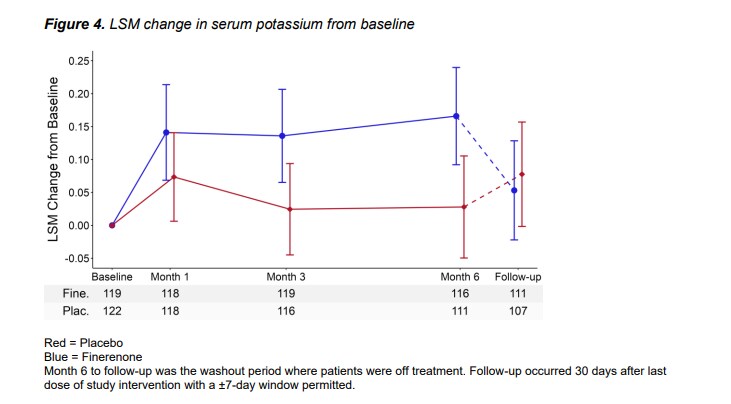
At month 1, serum potassium increased with finerenone to (0.14 mmol/liter [95% CI: 0.07, 0.21) with a LSM difference between finerenone and placebo of 0.07 mmol/liter (95% CI: –0.03, 0.17). The increase in serum potassium continued with finerenone throughout the treatment period before returning to baseline within 30- days of stopping treatment (Figure 4).
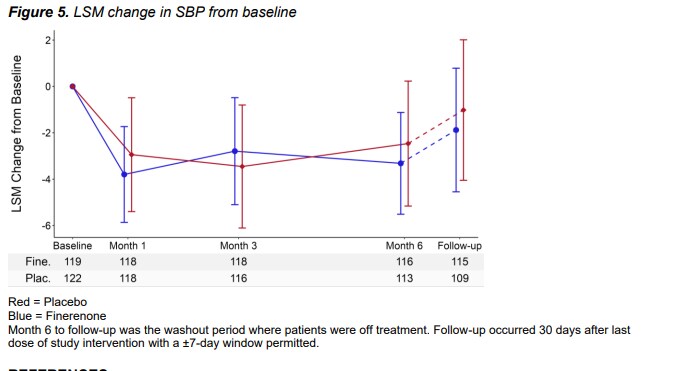
At month 6, the difference in change from baseline in SBP between finerenone and placebo was -0.9 mmHg (95% CI -4.3,2.6) (Figure 5).
REFERENCES
- Heerspink HJL, Birkenfeld AL, Cherney DZI, et al. Finerenone in Type 1 Diabetes and Chronic Kidney Disease. N Engl J Med. 2026;394(10):947-957 [incl. supp and protocol]. PMID: 41780000
- Tuttle KR, Wong L, St Peter W, et al. Moving from Evidence to Implementation of Breakthrough Therapies for Diabetic Kidney Disease. Clin J Am Soc Nephrol. 2022;17(7):1092-1103. PMID: 35649722
- Poulsen CG, Jesse K, Carstensen B, et al. Prognosis for Type 1 Diabetes with Diabetic Nephropathy between 2000 and 2020 - Changes in Kidney Function Decline Over Time and Development of Cardiovascular Disease, Kidney Failure, and Mortality. Kidney Int Rep. 2024;9(12):3403-3413. Published 2024 Sep 21. PMID: 39698347
- Heerspink HJL, Agarwal R, Bakris GL, et al. Design and baseline characteristics of the Finerenone, in addition to standard of care, on the progression of kidney disease in patients with Non-Diabetic Chronic Kidney Disease (FIND-CKD) randomized trial. Nephrol Dial Transplant. 2025;40(2):308-319. PMID: 38858818
- Sridhar VS, Limonte CP, Groop PH, et al. Chronic kidney disease in type 1 diabetes: translation of novel type 2 diabetes therapeutics to individuals with type 1 diabetes. Diabetologia. 2024;67(1):3-18. doi:10.1007/s00125-023-06015-1. PMID: 37801140
- Bakris GL, Agarwal R, Anker SD, et al. Effect of Finerenone on Chronic Kidney Disease Outcomes in Type 2 Diabetes. N Engl J Med. 2020;383(23):2219-2229. PMID: 33264825
- Pitt B, Filippatos G, Agarwal R, et al. Cardiovascular events with finerenone in kidney disease and type 2 diabetes. N Engl J Med 2021;385:2252–63. PMID: 34449181
- Heerspink HJL, Birkenfeld AL, Cherney DZI, et al. Rationale and design of a randomised phase III registration trial investigating finerenone in participants with type 1 diabetes and chronic kidney disease: The FINE-ONE trial. Diabetes Res Clin Pract. 2023;204:110908. PMID: 37805000


Follow Us
Follow Us


