

Finerenone Concomitant use of Sodium–Glucose Cotransporter 2 Inhibitors in heart failure patients
SUMMARY
- The efficacy and safety of finerenone vs placebo (in addition to usual therapy) in 6001 patients with symptomatic heart failure (HF) (New York Heart Association [NYHA] class II-IV and left ventricular ejection fraction [LVEF] ≥40%) with or without diabetes and/or chronic kidney disease (CKD) was evaluated in a randomized, double-blind, parallelgroup, placebo-controlled, event-driven phase III trial, FINEARTS-HF.1-3
- A prespecified analysis of FINEARTS-HF reported that 13.6% of patients were on sodium– glucose cotransporter 2 inhibitors (SGLT2i) at baseline. Patients on an SGLT2i at baseline experienced a recent worsening HF event, had higher levels of natriuretic peptides, and had higher rates of diabetes mellitus and CKD. The relative effects of finerenone in reducing the risk of primary outcomes (cardiovascular [CV] death and total worsening HF events) were similar, regardless of baseline treatment with an SGLT2i. Because those treated with an SGLT2i faced higher risks of clinical outcomes, the absolute rate reductions observed with finerenone were nearly double in the SGLT2i-treated subgroup.3
- During 2.6 years median follow-up, patients on baseline SGLT2i had higher risks of primary outcomes compared to those who were not on an SGLT2i at baseline (24.2 vs. 15.2 per 100 patient-years; rate ratio [RR], 1.57; 95% confidence interval [CI], 1.30-1.88; P <0.001). Finerenone reduced the primary outcome risk similarly in both SGLT2i users (RR, 0.83; 95% CI 0.60-1.16) and non-users (RR, 0.85; 95% CI, 0.74–0.98) vs placebo (Pinteraction = 0.76), with a greater absolute rate reduction (ARR) in SGLT2i users (4.7 vs. 2.5 events per 100 patient-years). Over 2.6 years, fewer patients in the finerenone group initiated SGLT2i during the trial compared with placebo (17.7% vs. 20.1%; hazard ratio [HR], 0.86; 95% CI, 0.76-0.97), with no significant change in finerenone treatment effects on a first primary endpoint (HR, 0.85; 95% CI, 0.76-0.95; P = 0.003).3
- Serious adverse events (AEs) were comparable between treatment arms, with low incidences of hyperkalemia-related hospitalizations.3
- An ongoing phase III, international, randomized, double-blind, placebo-controlled study (CONFIRMATION-HF) is assessing the efficacy and safety of finerenone in combination with SGLT2i in hospitalized patients with HF (independent of LVEF).4
This page is intended for US healthcare professionals and may contain information outside of the approved prescribing information. It is provided in response to an unsolicited request. It is not intended as an endorsement of any usage not contained in the Prescribing Information. This response should be reviewed together with the current full Prescribing Information (including Boxed Warning) and Medical Safety Summary. These materials contain the approved indications, contraindications, warnings and precautions, adverse reactions, and other important safety information for Kerendia® (Finerenone).
Kerendia is a non-steroidal mineralocorticoid receptor antagonist (nsMRA) indicated to: reduce the risk of sustained estimated glomerular filtration rate (eGFR) decline, end-stage kidney disease, cardiovascular death, non-fatal myocardial infarction, and hospitalization for heart failure in adults with chronic kidney disease (CKD) associated with Type 2 diabetes mellitus (T2DM); reduce urinary albumin-to-creatinine ratio (UACR), which is expected to reduce the risk of sustained eGFR decline and end-stage kidney disease in adults with CKD associated with Type 1 diabetes mellitus (T1DM); reduce the risk of cardiovascular death, hospitalization for heart failure, and urgent heart failure visits in adults with heart failure with left ventricular ejection fraction (LVEF) ≥ 40%.
CLINICAL DATA
- FINEARTS-HF was a randomized, double-blind, parallel-group, placebo-controlled, event-driven phase III trial that evaluated the efficacy and safety of finerenone vs placebo (in addition to usual therapy) in 6001 patients with symptomatic HF (NYHA class II-IV and LVEF ≥40%) with or without diabetes and/or CKD. Finerenone was dosed at baseline according to kidney function, as follows (Figure 1)1:
- A starting dose of finerenone at 10 mg once daily (OD), with a target dose of 20 mg OD, for patients with an estimated glomerular filtration rate (eGFR) ≤60 mL/min/1.73 m2.
- A starting dose of finerenone at 20 mg OD, with a target dose of 40 mg OD, for patients with an eGFR >60 mL/min/1.73 m2.
Figure 1. Study treatment intervention1
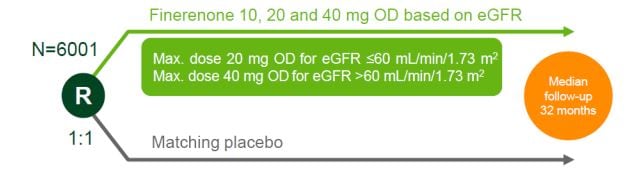
Abbreviations: eGFR, estimated glomerular filtration rate; OD, once daily; R, randomization
Source: Figure 1 was adapted from Solomon SD, McMurray JJV, Vaduganathan M, et al. Finerenone in Heart Failure with Mildly Reduced or Preserved Ejection Fraction [downloaded 26 Sep 2025]. Copyrights remain with the original source or as denoted therein.
The primary outcome was a composite of total worsening HF events (with an event defined as a first or recurrent unplanned hospitalization or urgent visit for HF) and death from CV causes.1,2
A prespecified analysis of FINEARTS-HF evaluated the efficacy and safety of finerenone in patients with and without concomitant SGLT2i treatment3 :
- Overall, 817/6001 patients (13.6%) were treated with an SGLT2i at baseline; dapagliflozin (48.7%), empagliflozin (47.2%), and canagliflozin (3.0%) were the most frequently used SGLT2i treatment. Patients who were treated with an SGLT2i at baseline were more likely to be men, experienced a recent worsening HF event, and had higher levels of natriuretic peptides compared with non-SGLT2i users. Among SGLT2i users, 75.4% had a history of diabetes and 55.0% had an eGFR <60 mL/min/1.73 m2 . Patients treated with an SGLT2i were at higher risk for a broad range of clinical outcomes. In light of higher baseline risks, the absolute benefits of the addition of finerenone in the SGLT2i-treated subgroup were magnified.
- Over 2.6 years median follow-up, patients on an SGLT2i were at a higher risk of CV death and total worsening HF events (24.2 vs. 15.2 per 100 patient-years; RR, 1.57 [95% CI, 1.30–1.88]; P <0.001). Risks of all other key endpoints were higher in patients with baseline SGLT2i use, including CV death, total worsening HF events death, all-cause death, CV death or first worsening HF event, CV death or first HF hospitalization.
- Treatment with finerenone similarly reduced the risk of the primary outcome with SGLT2i (RR, 0.83 [95% CI, 0.60–1.16] vs placebo; ARR, 4.7/100 patient-years) and without an SGLT2i at baseline (RR, 0.85 [95% CI, 0.74–0.98]; ARR, 2.5/100 patient-years) (Pinteraction = 0.76). Because of higher baseline risk, ARR was higher in patients with baseline SGLT2i use (4.7 vs. 2.5 total events per 100 patient-years) (Figure 2).
- During 2.6 years median follow-up, 980 patients initiated SGLT2i, which was less frequent in the finerenone arm compared with placebo (17.7% vs. 20.1%; HR, 0.86 [95% CI, 0.76- 0.97]). Time-updated analyses, accounting for both baseline and subsequent SGLT2i use, did not meaningfully alter finerenone treatment effect on the primary endpoints.
- Patients in both treatment arms experienced similar incidences of serious AEs, irrespective of concomitant SGLT2i use. Incidences of hyperkalemia leading to hospitalization were relatively infrequent and there were no cases of hyperkalemia leading to death in either group. At 1 month, finerenone increased potassium levels by +0.19 mmol/L (0.17–0.21) in those not treated with SGLT2i and +0.19 mmol/L (0.13–0.25) in those treated with an SGLT2i at baseline (Pinteraction = 1.00).
Figure 2. Treatment effects of finerenone on primary endpoint by concomitant SGLT2i use3
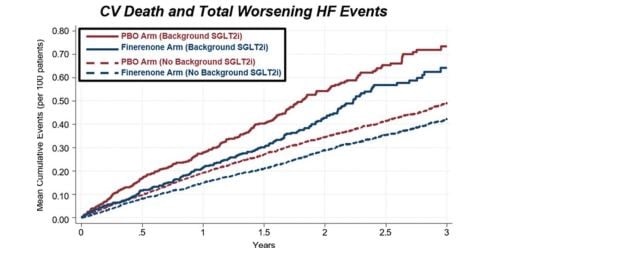
Abbreviations: CV, cardiovascular; HF, heart failure; PBO, placebo; SGLT2i, sodium–glucose cotransporter 2 inhibitor
Source: Figure 2 was adapted from Vaduganathan M, Claggett BL, Kulac IJ, et al. Effects of the Non-Steroidal MRA Finerenone with and without Concomitant SGLT2 Inhibitor Use in Heart Failure. [downloaded 26 Sep 2025]. Copyrights remain with the original source or as denoted therein.
Ongoing trial
CONFIRMATION-HF is a phase III, international, randomized, controlled, open-label, trial assessing the efficacy and safety of finerenone, in combination with SGLT2i, in hospitalized patients with HF. Primary outcomes are time to all-cause mortality, total HF events, time to first HF event, Kansas City Cardiomyopathy Questionnaire-Total Symptom Score (KCCQ-TSS) assessed by the win-ratio method, a number of serious AEs, and number of AEs leading to discontinuation of finerenone. More details can be found at: NCT06024746.4
LITERATURE SEARCH
A literature search of Embase® , PubMed® , and/or other resources, including internal/external databases, was conducted pertaining to this topic on 26 September 2025.
References
All the references were accessed on the abovementioned literature search date.
- Solomon SD, McMurray JJV, Vaduganathan M, et al. Finerenone in Heart Failure with Mildly Reduced or Preserved Ejection Fraction. N Engl J Med. 2024;391(16):1475-1485. PMID: 39225278 https://www.ncbi.nlm.nih.gov/pubmed/39225278
- Solomon SD, Ostrominski JW, Vaduganathan M, et al. Baseline characteristics of patients with heart failure with mildly reduced or preserved ejection fraction: The FINEARTS-HF trial. Eur J Heart Fail. 2024;26(6):1334-1346. PMID: 38733212 https://www.ncbi.nlm.nih.gov/pubmed/38733212
- Vaduganathan M, Claggett BL, Kulac IJ, et al. Effects of the Non-Steroidal MRA Finerenone with and without Concomitant SGLT2 Inhibitor Use in Heart Failure. Circulation. 2024;151(2):149-158. PMID: 39340828 https://www.ncbi.nlm.nih.gov/pubmed/39340828
- ClinicalTrials.gov. A Study to Determine the Efficacy and Safety of Finerenone and SGLT2i in Combination in Hospitalized Patients with Heart Failure (CONFIRMATIONHF) (CONFIRMATION). Identifier: NCT06024746. Updated March 11, 2025. Accessed 25 September 2025. Available at: Link


Follow Us
Follow Us


